Ultimate Direction – PB Adventure Vest 2.0 Review

Peter Bakwin wanted a pack that could do anything from running to hiking, climbing to skiing. Featuring 11 L of volume and a variety of features, The Ultimate Direction Adventure Vest 2.0 allows you to stay hydrated and comfortable on any size adventure from quick outings to all-day expeditions.
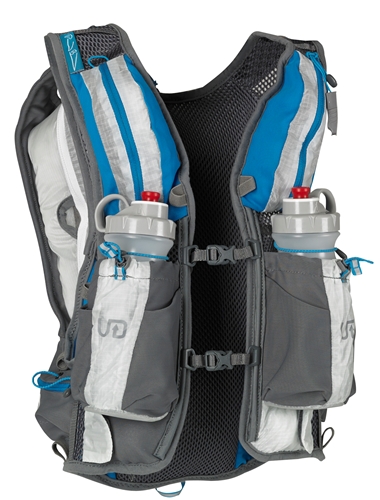
UD Adventure Vest

After running our first few races in an old Camelbak that I retained from my Air Force days, and tired of the way it flopped around on my back while running, I wanted to find a better fitting hydration pack.  I knew I wanted the pack to be small and light weight for sprint-style races (5-12 hours), but I also wanted it to be large enough to hold a few items such as a rain jacket, Clif Bars, Energy Gels, etc.  We recently bought my wife a Nathan Intensity Vest that she loves and I was intrigued by the running vest concept.  After looking on the internet for a while and reading plenty of reviews, I settled on the Ultimate Direction PB 2.0 Adventure Vest.  The reviews for the original Peter Bakwin Adventure Vest were very good and I knew that Ultimate Direction was coming out with the 2.0 version so I waited and waited until it became available.  And let me tell you, it was worth the wait.

UD Adventure Vest back

For one, the vest just looks awesome.  I know you hardcore adventure racers don’t care about looking awesome, we run around in tights for goodness sake, but who wants an ugly pack?  Not me.  The most important thing to me was fit.  I wanted something that didn’t slosh around on my back and yet didn’t chafe.  Out of the box, this vest fit perfectly.  I’m 5’10” 160lbs with a 38″ chest and putting the pack on was like slipping into my favorite pair of socks.  It just hugs the body comfortably.  You can see how it sits on the body from the image below:
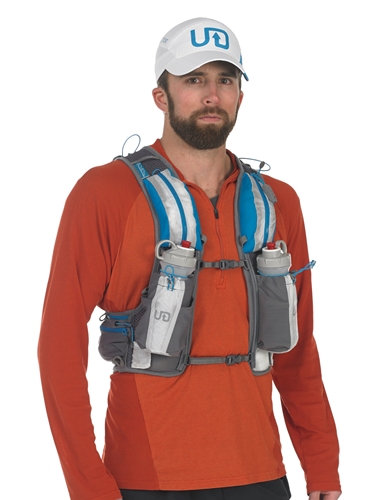
UD Pissed Off Dude

Now, I don’t know why this guy looks so pissed off, when I put on the vest I was all smiles, I just knew it was going to work great.  Who’s the happy adventure racer in the picture below…that’s right, this guy!
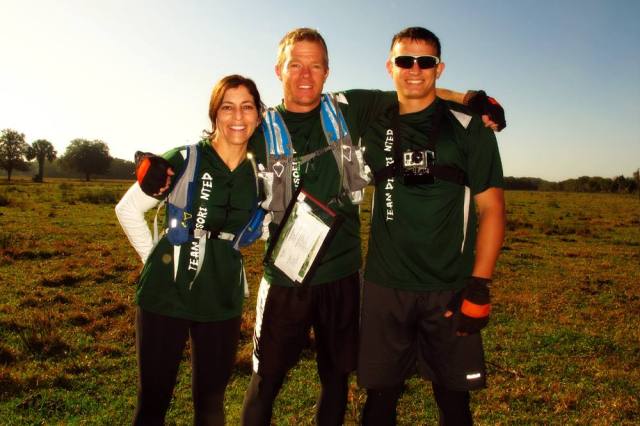
1602008_10151980460306375_971970453_o

The way that the vest sits higher on the torso means that it doesn’t get in the way when you run, cycle, or paddle.  In fact, during our training days that can last up to 6 hours and during the races that we’ve done, the vest is barely noticeable.  There are compression straps and adjustment straps all over the vest that allow the wearer to customize the fit to their body and depending on the pack contents.  I thought that having the bottles in front might be strange, but it wasn’t.  For my pack, I opted for the optional hydration pack so I have 70 ounces of water in the back and 2, 20 ounce bottles in the front that I usually fill with Gatorade.  I really like the hydration options this vest allows.  We’ve run races where we had just the bladder in the back with water and after about 3-4 hours, I needed something with flavor.  Plus, with extra bottles on my bike or in my gear bin, I can quickly replenish during transitions.
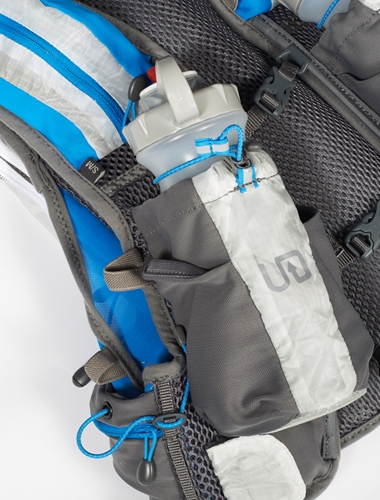
Closeup

The vest is loaded with pockets and I really like how they snuck in a few pockets for Gel packs right by the water bottles.  You can access the side pockets with a little contortion of the body but to access the rear pouch, you’ll have to take the vest off.

The build quality of the vest is top-notch and it is very similar in quality as the Nathan vest my wife has.  From the Ultimate Direction website:

  • Silnylon 66: Impregnating nylon with Silicon and Polyurethane creates this permanently waterproof fabric, and also substantially increases its seam and tear strength.
  • Hex Mesh: The Hex Mesh vest structure is completely breathable, extremely strong, and lightweight. Its inability to absorb moisture results in a drier, more comfortable wear.
  • Power Mesh: All pockets are strong and stretchy, made with heavy duty 340gm Power Mesh stretch fabric so the vest expands as you need it.

I can confirm that the vest is extremely breathable.  Since we train and race in Florida, this is very important.  The grey material is extremely stretchy but tough, so a lot can be packed into the pockets and pouch.  I haven’t been caught in the rain yet, so I can’t speak on how waterproof the fabric is.  I’m sure it’s only a matter of time before I can report on that.
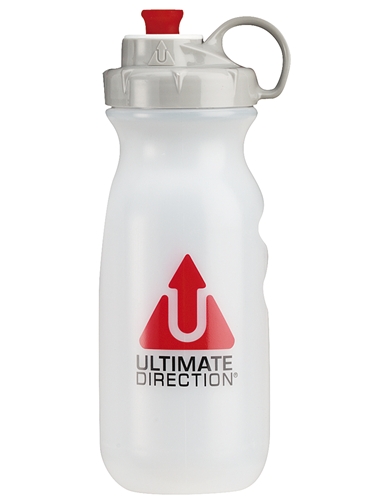
bottle

The vest comes with 2, 20-ounce water bottles with a “Kicker Valve.”  Funny thing about the kicker valve is that I didn’t know how they worked when I first got the vest.  Seems you have to pull really hard on the red squishy part until it pops out, then suck and squeeze the bottle.  Kick the red part to one side and it pops back down, creating a leak-proof seal.
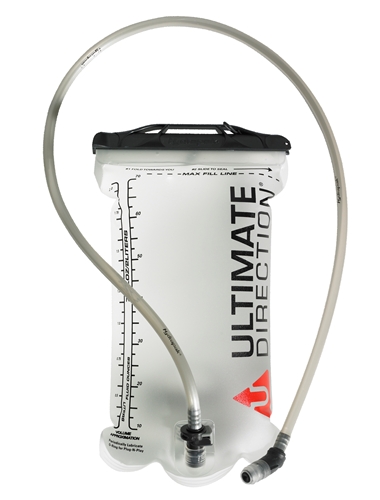
bladder

The optional 70 ounce bladder is very nice with a bite valve and fold-over top closure.  I’m a big fan of the fold-over top closure as I find it is easier to fill than the screw on tops and also easier to clean.  You can also unplug the hose, leaving it threaded through the vest for bladder refills.

Negatives:

  1. The hydration bladder is a pain to put in the pack when full although the side zipper really helps.  This really isn’t a big issue for me as I only fill it once before the race and with the additional bottles I have plenty of fluids.  I wouldn’t use the vest for long races +12 hours where I would need to refill the bladder since I don’t think the pack would be large enough to carry the extra gear I would carry.  But, I do like how there is a slot for the bladder and it can be held in place with internal compression cords.
  2. Price.  I think the vest alone is pricey and when you add in the optional hydration bladder (yes, you have to pay for this) then the pack gets down right expensive.  Given the high-end materials, the build quality and the overall form, fit and function of this vest, I think it’s worth it.

I plan on updating this review as I use the vest more.  If anyone has any questions, just post them in the comments section and I’ll update the post.

For now, I am extremely happy with the vest and very glad I waited to get it.

4/24/2014 Update – I have now used the Ultimate Direction PB Adventure Vest 2.0 while training for the past 1.5 months and I have used it during 2 adventure races, one was 6 hours long and the other was 10 hours long.  The vest has worked flawlessly and the more I wear it, the more I love it.  So far I haven’t found anything wrong with it at all and it continues to exceed my expectations with regard to comfort and utility.  For the 10 hour race, I strapped my rain jacket to the outside and carried a number of gel packs, cliff bars, and other snacks in the pockets.  I also carried my mobile phone in a waterproof container (safety requirement).  At times I wish the vest was slightly bigger, but then I would just fill it up with stuff I didn’t really need.  The small size makes me keep the contents down to the bare necessities and that makes me lighter and faster.I have yet to refill the internal bladder while racing because between the bladder and the external bottles I have had plenty of fluids.  I imagine that summer races in Florida may drive me to refill the bladder mid race, we’ll see.  So far, I have to conclude that you can not go wrong with this pack.  During the races, I hardly notice that I am wearing the pack.  The fit is perfect and it doesn’t flop around like my CamelBak used to.  I am 5′ 10″, 160lbs, medium build and wear a 38-40 jacket for size reference. I bought a M/L vest.
Pangea – BOAR AR (aka: Damn You Canoe!)

Team Disoriented made the 6.5 hr trek to Christmas, FL to race the Pangea BOAR Adventure Race.  Unlike last time, we actually showed up to the Main Transition Area (TA) prior to the 7AM registration time so that we could get our maps and instruction booklet as early as possible.  

Boar AR Elite Instructions

EliteBoatv2

EliteMiddlev2

EliteSouthv2

We even had a gear bin rather than having our stuff scattered in the back of the SUV.  However, as we tried to map out our course using the top of the gear bin as a working surface, we quickly discovered how nice it would be to have a table (next item on the gear list).

Planning

The funny thing about Adventure Racing is that I can never get it in my head what we are allowed to do and not.  The Main TA was right next to a cow field and Checkpoint 1 (CP1) was located within the field with real, live cows and I’m asking Ana and Stu, “Are we supposed to go through the cow field?  Are we supposed to hop over this fence or somehow go around?” Well the answer became evident as soon as Greg directed us to stage our bikes on the other side of the fence, in the field.  OK, game on, let’s go play with the cows.

The race started with a short sprint to spread the field prior to getting on the bikes and getting CP1-CP4.  We hit CP1 by following the pack, and headed toward CP2 where we started encountering our first cows.  I hear Stu shout, “That dude just got attacked by a cow.”  It seems that Nate from the Canyoneros did something to piss off one of the bovines and it decided to charge him.  I don’t think the cow actually did anything but that charge would have been enough for me to add my own cow patty to the field.  And speaking of poop, there were cow patties a plenty in Christmas.

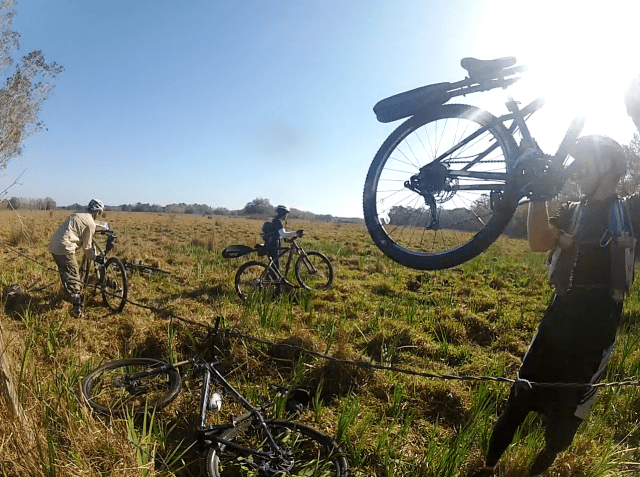
We picked up CP2 and the on our way to CP3, the terrain got worse.  At one point, I hit a hole that just swallowed my front tire and I did a beautiful pirouette over my handlebars.  The terrain had us moving so slowly that my flip looked like one of those slow-motion clips from the Matrix.  There was nothing I could do.  Of course, when I put my hand down to catch my fall, it landed right in the middle of a cow patty.  Somewhere in Christmas there’s a 12-inch high pile of poo with my palm print in it.  After hopping the fence between CP2 and CP3, the ground got so rough that we couldn’t pedal our bikes and ended up running with them for about 200 yards.  Pedalling again, we picked up CP3 and CP4 before heading to the Boat TA.

Hike_a_bike

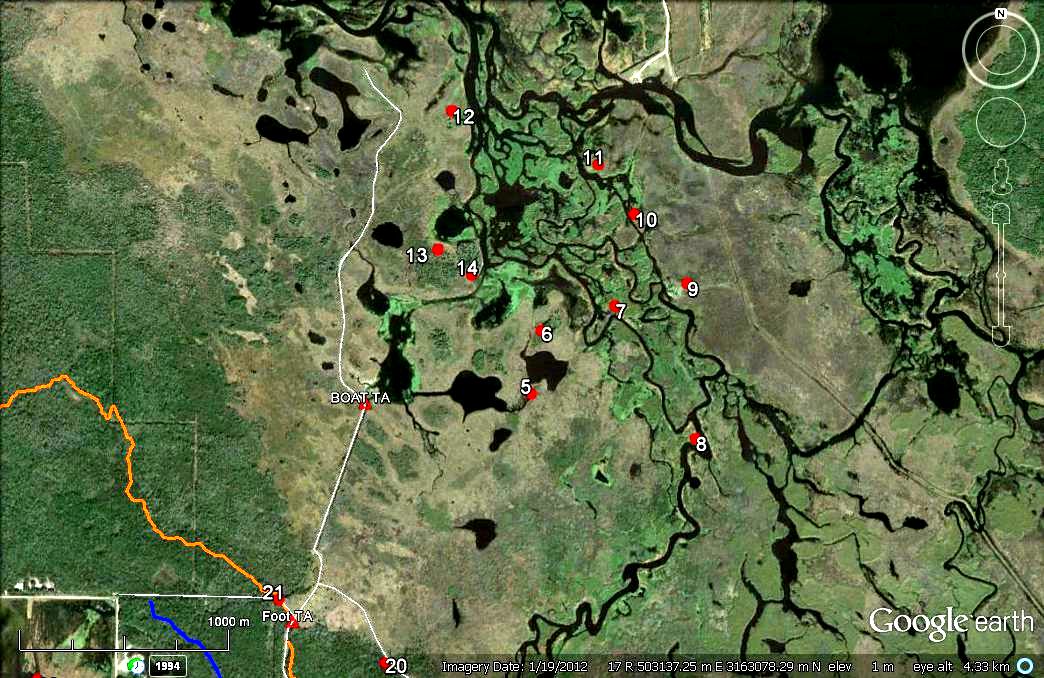
We got to the Boat TA and I thought we were doing pretty well.  Of course the fast teams were already gone but I thought we were solidly mid-pack at this time.  But then it all started to fall apart.  Our transition to the boat was slow as we trepidly launched, trying not to capsize at the start again.  Of course Ron heckled us by saying, “Let me know if anyone plans on capsizing so I can get my camera ready!”  Well, we didn’t capsize but we didn’t break any speed records either.  Realizing that canoeing isn’t our strong suite, our plan was to go east and pick up CP5 and CP6, then head back to the Boat TA where we would head north to pick up CP14, 13, and 12 since these looked easy enough.  We figured that CPs 7-10 could get tricky given all the twists and turns of the river and we would have to make the call on the fly, depending on how settled we felt in the boat and how much time we had been on the canoe.

canoe portage 4

From the Boat TA, we zigged and zagged across the large lake towards CP5 and joked with the canoes behind us that we were maneuvering to keep them from passing.  Of course, being so slow, there was no way we could keep anyone from passing us.  We got CP5 and CP6 without issue but then saw other teams portaging east from CP6 to pick up CP7.  This made us reconsider our plan and we decided to follow suite.  Stu practically yanked the canoe across the wetlands by himself while I had to keep pulling Ana out of thigh-high muck.  We got to CP7 by following the SW bend in the river, while other teams simply cut across.  We then headed down to CP8, which we got without issue.  From CP8, we started running into issues.  I hadn’t measured the distance between CP8 and CP9 so I wasn’t sure of how far it was and we ended overshooting CP9.  We paddled all the way to CP10 where we ran into other racers and learned of our mistake.  At least we picked up CP10 while we were there.  We then decided to pick up CP11 since it was so close, skip CP12, and head back down to pick up CP9 before returning to the Boat TA.  We landed where we thought CP11 was and hunted around for WAY TOO LONG before finally giving up.  That was totally my fault as I didn’t want to give up on the CP.  Taking a look at the GPS track, you can see we weren’t anywhere close to CP11.  We had once again overshot our target.

CP11 Where are You

Giving up on CP11, we started to head south to CP9 but then got turned around in the numerous channels between CP11 and CP10  We were frustrated at this point and ready to get off the canoe and I am grateful for not being smacked with a paddle.  We finally got to CP9, made the punch and headed north again to hit the east-west channel just south of CP10 that would take us to CP14.  Once again, we overshot our target and went all the way back to CP11 and picked up a channel there that ended up taking us to CP14.  Not measuring the distance between checkpoints and estimating paddling time was plain stupid on my part and cost us.  We picked up CP14 then CP13 without incident and headed to the Boat TA.

From the Boat TA, we went to the Foot 1 TA to begin the orienteering section.  We decided to hit these in order, CP15-20, after some gentle coaxing from Ron.  We found 15-17 without incident but lost some time finding CP18.  We did find a snake basking on a palm frond, but didn’t get close enough to identify the type.  I’m sure it was poisonous, probably the deadliest snake in Florida because, well, that would just make my blog post cooler.  Anyway, CP19 and CP20 were found alongside a trail straight out of Tough Mudder and I’m proud to know that my shoes and socks aided the demucking processing going on at the Orlando Wetlands.

Snake

From Foot 1, we went to the Main TA and decide to hit the final Bike Segment picking up the CPs in reverse order.  Here I almost made another stupid mistake, thinking that CP22 was our last checkpoint on this segment.  Luckily, we checked the punch before heading back to the Main TA and noticed that one punch was missing.  We picked up CP21 and then headed back, arriving at the Main TA at 2:55.  Not wanting to give up without a fight, we decided to try for at least one if not two Foot 2 CPs.  I knew we should be able to get CP31 and return before time expired, so off we raced.  Thinking that I had seen CP31 from the road earlier in the race, we ended up overshooting it.  We backtracked, read the Instruction Booklet and realized it was buried in the woods off of the blue trail.  We finally found it but had no more time to lose and raced back to the Main TA, checking in at 3:07 and just missing a 1 point penalty.  (Post race note: If you’re used to Pangea races you probably realized that if teams are 1 second over the stop time they are docked 1 point.  During the race I was recalling another AR that we did where racers had up until 10 minutes after the stop time to check in without being docked.  So in the end, that extra point we raced off for was fruitless since it was subsequently taken away because we came in late.  Another stupid mistake but at least it didn’t really cost us anything.)

In summary, I thought we had done really well in all the segments except the Canoe leg.  I was really proud of how the team pushed to get that one extra CP at the end.  I know that I made quite a few navigational errors that cost us time but in the end we did okay for our 3rd race and we had a great time.  I couldn’t find two better teammates.

1602008_10151980460306375_971970453_o

Good grief, we suck!

We went out on Saturday for a long training day and I really only had 2 goals, ride for 32 miles on hard pack trails and canoe with all 3 of us in a canoe for 1-2 hours.  The bike ride went fine, but when it comes to canoeing, we suck.

016

I really don’t understand it.  It seems that no matter how hard we try, or how smooth we try to paddle, we can’t go in a straight line to save our lives.  I will say that after about an hour, we did get slightly better.  I would say we improved to the level of, “We almost don’t suck.”  But then we’d get excited, lose concentration and zig zag or do circles for the next 15 minutes.  In the end, we could only maintain a track if I was steering from the rear using the paddle as a brake.

Ana and I have gone out a number of times before and everything seemed to go fine, we could maintain a track, we could even put in corrective strokes when we got slightly off course.  But once we get 3 people in the boat, it all falls apart.  And no, I’m not blaming Stu.  I think having 3 people really changes the dynamics of the boat and we haven’t figured out how to deal with this yet.  It definitely makes the boat more tippy.

Unfortunately, I haven’t been able to find any helpful information on the internet about paddling 3 people in a canoe using kayak paddles.  Pangea has some info on paddling for adventure races and here is a video clip from Ron Eaglin.

Locally, we are having a canoe paddling clinic that I think I’ll sign up for.  But I doubt it will be applicable to 3-person kayak style paddling.  So, if any of my 4 readers find any good information or videos on paddling, please send me a link.  Until then, we’ll keep providing the comic relief at our races.  Have the camera ready, because someone’s probably going to get wet.

Pangea – Sea 2 Sea Adventure Race

We didn’t race the Pangea Sea 2 Sea, so I can’t offer much from a racer perspective.  For a race report, you’ll have to check out Ron Eaglin’s blog or the Canyoneros.  Plus, I’m a noob, so what do I know anyway.  However, since we hope to race it next year, I thought I would be a race volunteer so that I could get a better appreciation of a 72-hour race.  I did come away with a few tidbits that may be of use…maybe not.  So, if you’re interested, read on.

#1 Grab bikes by the handlebar and seat POST

If you’re a volunteer loading bikes and a racer passes you the bike that they have been riding for multiple hours, don’t grab it by the seat pad as one might typically do.  That seat has been sponging up butt sweat for the last few hours and is just waiting for your hand to splash down onto it.  But don’t worry, if you forget this rule, it’ll only take one or two incidences before it’s committed to memory for life.

#2 Florida can get cold…really cold…and wet…and sometimes it is really cold and wet, and that sucks

Adventure racing in Florida, “The Sunshine State”, how bad can it get.  Well, it can get really bad.  There is something about the damp coldness here that can chill you to the bone making it almost impossible to warm up.  So, don’t let the moniker fool you, sometimes this isn’t the sunshine state so don’t be fooled into not packing adequate cold and wet weather gear.

1597085_727308357303968_628565743_o

#3 Chill dude, it’s going to be OK

If your bike, paddle bag, gear bin or whatever is not ready at a transition area (TA), relax, don’t get upset.  Sometimes, because of the way the racing field is spread out, racers get to TA’s before the volunteers can set it up.  Just make a note of when you arrived at the TA, the race director will be informed and concessions will be made.  The delay will not negatively affect your outcome and you can and should enjoy the moment to grab extra food, a little nap, or some friendly team bonding.  And, please don’t get upset with the volunteers, we don’t have any control over when we are sent to set up a TA.

#4 Lose the love for your bike

We all love our bikes, especially if you’ve sank $6k into a carbon fiber masterpiece.  Volunteers understand this and we really try to load the bikes in such a way as to avoid damaging them.  But, if getting a scratch on your bike is going to give you an embolism, it may be better for you to bring a trash bike that you don’t mind getting damaged.

1415061_728956283805842_1827320457_o

#5 I’m not stupid, just really tired

Volunteers probably don’t know as much as you would hope, or perhaps I should say this volunteer may not have known as much as some racers would have hoped.  For the Sea 2 Sea, some volunteers are there for the whole event and not getting much more rest than some of the racers, so they may not be as mentally alert as one would hope.  In addition, this may be the first event they have volunteered for so, unintentional mistakes will be made.  Just know that all volunteers are trying their best.

1547946_728480177186786_178328702_o

#6 Herding cats

Getting 24 teams and all of their associated gear across the state of Florida is not an easy task.  The race director, the staff, and volunteers are working very hard to make your race go as smoothly as possible.  If the race seems to go smoothly, believe me that it is organized chaos behind the scenes.

1932536_728483140519823_73538842_o

#7 Mark your shiznit

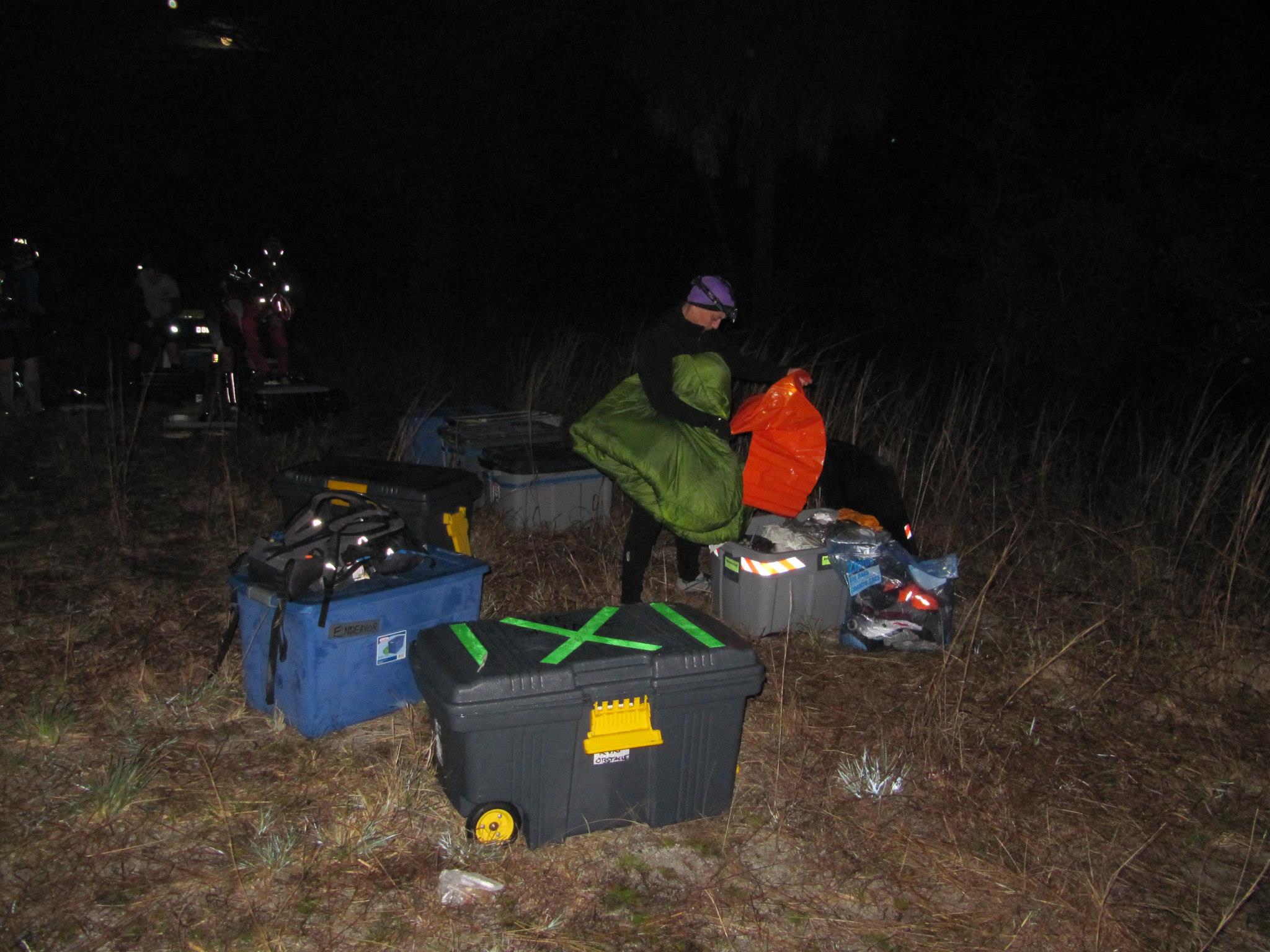
It’s your stuff, you’d probably like to find it quickly, especially in the dark when it’s cold and raining.  If your stuff is marked well, the volunteers will try their best to put all of your gear together.  What do I mean by marked well?  Each team member’s bike should have the team name clearly marked in a conspicuous location.  Gear bins should have large markings on them.  In addition, I would suggest using geometric shapes to mark your bins so that you can quickly find them.  See the bin marked with a large X below?  Super easy to spot, right.

1658255_728478693853601_345579250_o

#8 Dude, where’s my crap?

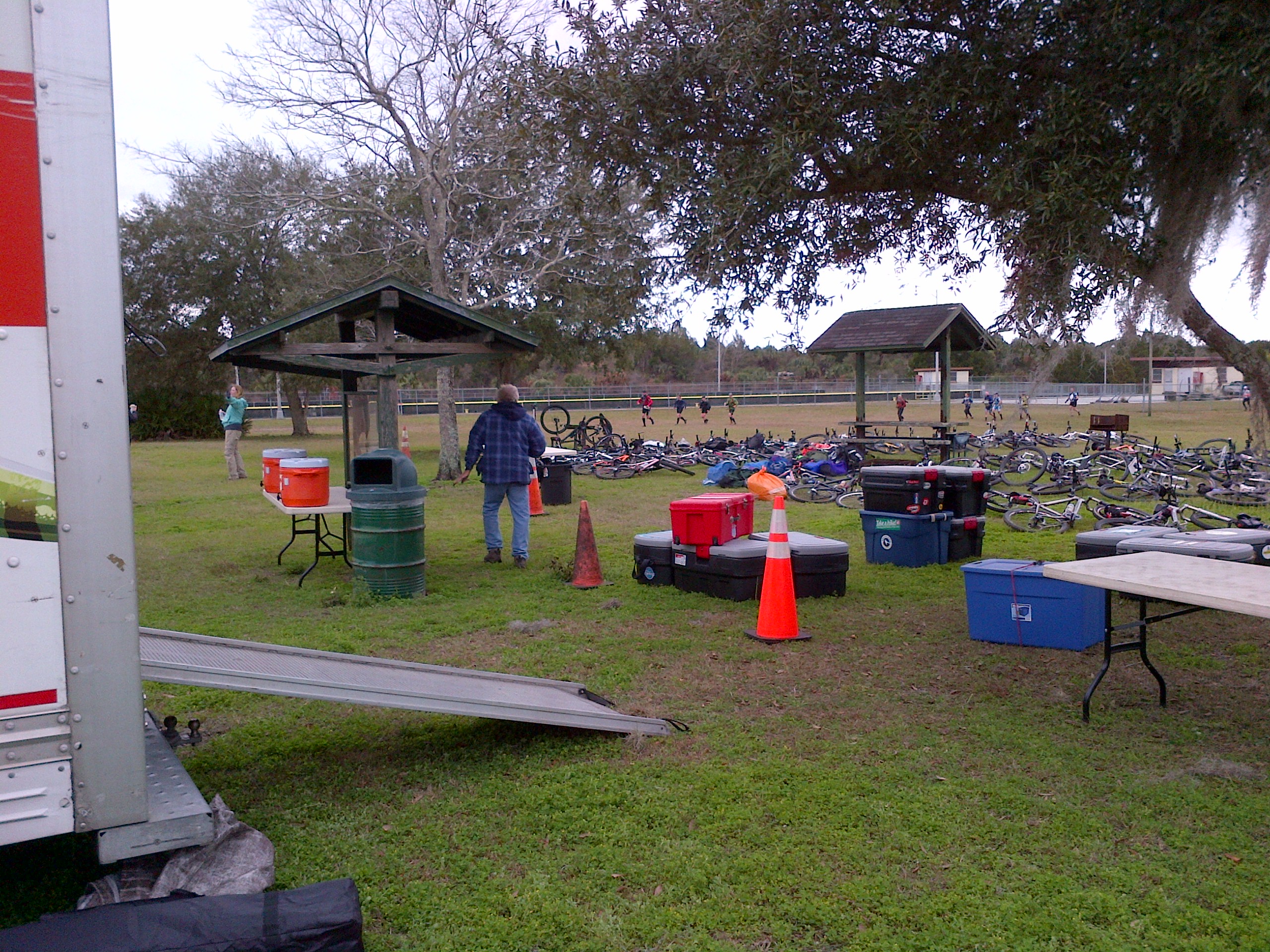
Bring all of your team bikes and bike bag to the drop off location together.  If you bring all of your gear to the drop off location as a team, you won’t have to worry about your stuff getting separated.  In addition, it will probably be loaded and unloaded at the same time, meaning that all team bikes and bike bag will be placed in the same area.  If you bring gear separately, it may not be unloaded and placed together, and worse yet it may get loaded on separate trucks and delivered at separate times. Note, this didn’t happen at the Sea 2 Sea because the volunteers were so awesome.

Cedar Key-Yankeetown-20140213-00363

#9 Make it a quickie

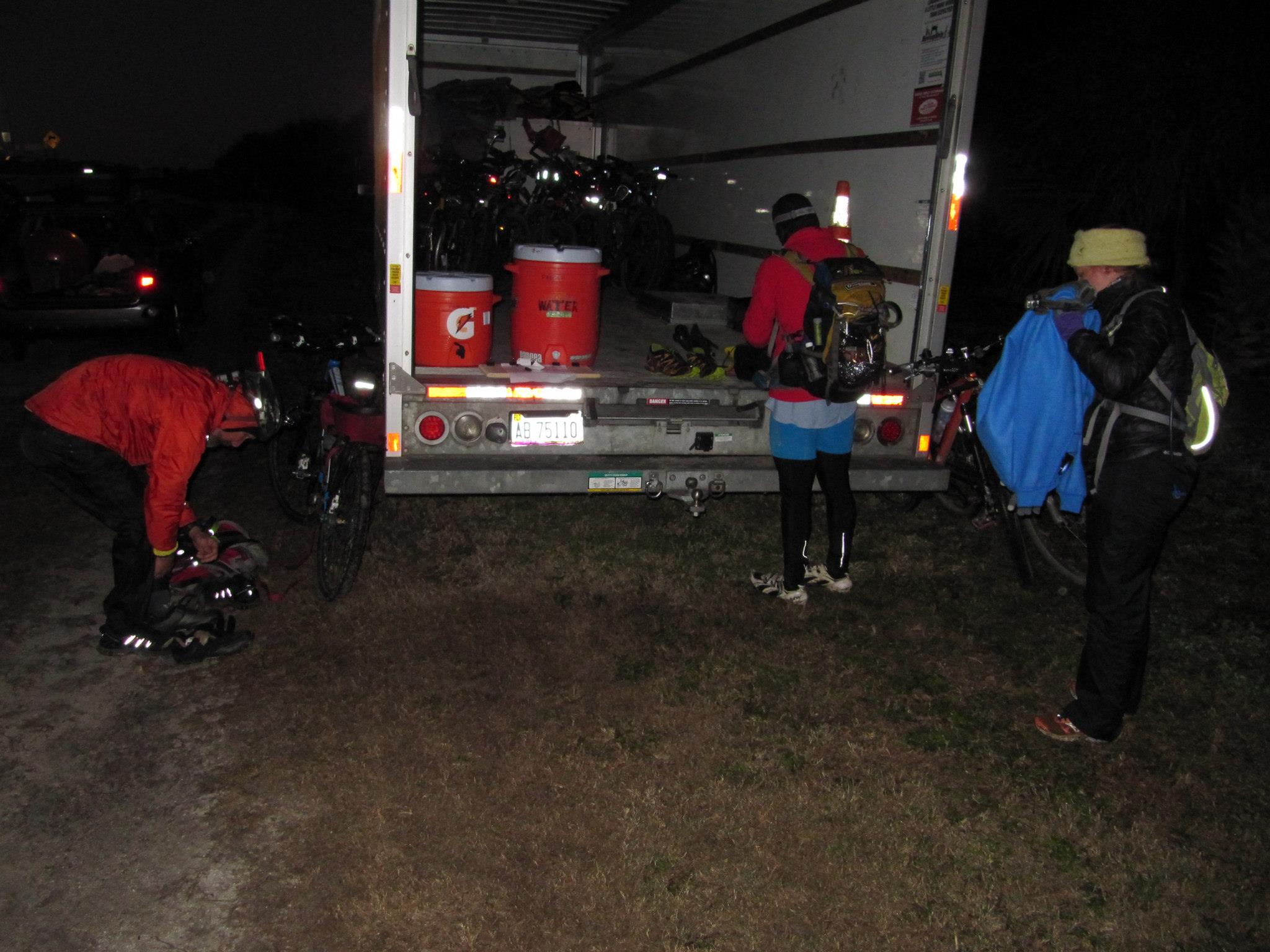
Teams train very hard to increase their endurance and speed and then they waste minutes in the Transition Area (TA).  Yes, some transitions will be slow but most can be sped up.  It’s hard to make up 10-15 minutes on the bike or canoe, but it is super easy to waste that time in a TA.  Make your transitions as quick as possible when you are planning on moving out, especially if you are cold and/or wet.  If you are already cold coming into the TA and your transition is slow, you will get increasingly colder the longer you hang around the TA.  When you come in, your body is still warmed from the physical exertion but as you linger around, that heat dissipates and you may find yourself too cold to continue.

1047946_728482617186542_1426607231_o

#10 Can we cuddle?

Florida can get very cold and wet, see #2 above.  With this in mind I would make 2 recommendations, keep a small tent in your gear bin and carry multiple emergency blankets and don’t hesitate to use them.  There may be times when you have access to your gear bin and need to rest your team.  Maybe the weather is particularly crappy, or a teammate needs a break before going on, wouldn’t it be nice to have a small tent that you could set up quickly to get out of the weather and rest a little.  Remember this is a 72 hour race and things happen.  A small tent is a nice luxury, especially since you won’t be carrying it.  Also, have multiple emergency blankets.  They are small, easily stored and you should have more than one so that there is never any hesitation to break one out.

1064411_728484917186312_1420344594_o

#11 Be somebody’s beyotch

Volunteer for a long race.  It is almost as fun as being in one and you will learn a lot.  Plus you get to scope out the competition’s gear and see if there are any ideas you like.  The other cool thing is that you get to meet many of the racers, and believe me Adventure Racers are the coolest people you’ll ever get to meet.

#12 Easy?  I got your easy right here!

Don’t be fooled, the Sea 2 Sea is not easy.  While most of the teams will finish, most of the teams will not clear the course.  Many will skip sections in order to make it to the finish in time.

1618239_10151954425666375_1370493539_o

Finally, I’d like to thank Greg, all the Pangea staff and the other volunteers for allowing me to be a part of this event.  I’d especially like to thank John and Jamie for sharing their sandwiches with me on those desolate TAs.  I had a great time and learned a lot.

Atomic AR – 30 Hour Adventure Race

The Pangea Atomic AR, thirty F@$*%! Fun-filled hours of adventure racing!  I’m at a loss, I don’t really know what to say.  I can’t even imagine what a 30hr race is going to be like.  I have an idea what my bottom is going to look like after being on a bike for that long…

Atomic Booty

Like all things that we do that are difficult, painful, and outside of my comfort zone, I blame Stu.  You see, instead of getting out of the Air Force so that he could continue to work with the coolest guy ever–me–he decided to stay in.  As a thank you, the AF has decided to move him to the great metropolis of Dayton, Ohio.  What this means is that Stu will soon be leaving Team Disoriented and the Atomic AR may be the last time we get to do an epic adventure race.

The Atomic AR is May 31st, so we have 17 weeks to prepare.  How does one prepare for a 30-Hr race?  I have no clue.  Ana keeps asking me how we’re going to train for it and I keep answering, “Well, we should probably do a lot of running, biking and canoeing…definitely a lot of canoeing based on our past results.”

Probably not the training plan she is looking for.  So, if you know of a good plan, please drop us a note in the comments section.  For now, we are putting together a plan based on David Kuehls book, “4 Months to a 4-Hour Marathon.”

We’ve used this book to train for a marathon and 1/2 marathon and we really like it.  It’s very easy to follow and has an easy step-by-step plan for achieving a 4 hour marathon pace.  I’ve tailored the plan for a 2-hour, 1/2 marathon while adding biking and canoeing into the schedule.

While not the training plan of an elite team, I hope that this plan is enough to get us prepared for tackling the Atomic AR.  One thing that I’m really looking forward to is the night training.  The final 2 weeks prior to the Atomic, we plan on doing our long training at night so we can get an idea of what it’s like to run, bike and paddle in the dark.  This will also give us a good opportunity to check out our gear before the race.

If you want to see how a real team trains, check out this video from Team Tecnu.  These guys are amazing.

  • 2Hr paddle
  • 1Hr Crossfit
  • 3Hr bike
  • 2Hr run

Want to know more about the Atomic AR?  Check out this video from Pangea.  It’s a little dated but you’ll get the idea.  And don’t forget, leave us your training suggestions in the comments section.  Oh, and if you’re in the area and would like to come train with us on our long days, send us an email: teamdisoriented at gmail .com

Toughest Race on Earth

Here it is January 28th in the sunshine state, the weather is crap  and my motivation level is about as high as the temperature.  So, instead of hitting the treadmill I’m hitting YouTube and watching the Discovery Channel’s, “Toughest Race on Earth with James Cracknell.”

If you’ve never heard of James Cracknell, don’t worry neither had I before watching this show.  Seems the guy is a British rowing champion and a double Olympic gold medalist, and rather famous on the other side of the pond.  I discovered him when I was looking for adventure racing videos on YouTube and when I saw the title, “Toughest Race on Earth” you know I had to check it out.  This documentary focuses on the running of the Marathon Des Sables.  Don’t know what that is either?  Well, neither did I.  It seems that the Des Sables is a 6-day ultra which is equivalent to running 6 regular marathons in a row.  Six!  Not tough enough for you?  Well, did I fail to mention that the Des Sables is ran in southern Morocco in a place you may have heard of, the Sahara desert!  Check out some nice photos here or click the image below:

des_sables

Basically, the documentary is about a 6 foot 4, 216lb gold medal rower who decides to tackle probably the toughest running event on the planet.  I won’t spoil the ending for you, you just have to check it out!  But believe me, watching the video should provide you with plenty of motivation to keep pushing during your next adventure race

Once you’re done with the video, you might want to check out his latest book, “Touching Distance” an autobiography that describes his athletic achievements as well as his struggles to recover from a biking accident where he was struck in the head by the side mirror of a passing semi while attempting to cycle, row, run and swim from Los Angeles to New York within 18 days

Wouldn’t you know it, now I feel guilty about my laziness.  Off to the treadmill!

Oak Mountain State Park Orienteering Course

Team Disoriented and Team Lil’ Disoriented headed out to Oak Mountain State Park, AL for some orienteering practice on their permanent O-courses.  As proven in the last AR, we’re in need of some orienteering practice.  We probably need some canoe practice as well, but that’s another issue.

Lil’ Disoriented with their game faces on!

Alabaster-Helena-20140126-00331

There are currently two O-courses maintained by the Vulcan Orienteering Club, the beginner course and the advanced course. Since we’re from Florida and not used to hilly terrain, our first stop was the beginner course. Looking at the beginner course map you can see that the checkpoints are all on major trails and rather easy to find.  But, by doing this course first, we were able to get some practice trying to match the terrain to the map. Surprisingly, there was a lot of variation in terrain.

Alabaster-Helena-20140126-00343In the picture above, you can get a feel for the landscape, open forest with many hills and small creeks.  We hit CP1, 2, and 3 rather quickly by following the trail. But once we hit CP3, we decided to put our nav skills to the test and left the trail and bushwhacked on a bearing straight to CP4.  We came upon CP4 easily so we did the same thing for CP5 and CP6, heading off-trail and bushwhacking straight to their locations.  Again, both were easy to find and it was a lot of fun taking the course at a leisurely pace.  After CP6, there wasn’t much reason to bushwhack so we stayed on trail and finished out the course.

It was getting late in the afternoon so we knew we wouldn’t be able to finish the advanced course, but we wanted to check it out and see if we could find a few CPs before heading home.  So, after a short break on a conveniently placed stump, reading material in hand, we pushed on.

Alabaster-Helena-20140126-00333

Taking a look at the Advanced Course Map you can see that these CPs are not on trails, but require a little bushwhacking to get to.  We decided to attempt CP5, 6, and 7 and leave the rest for another day.  CP5 was at the summit of a small but steep hill and we had a lot of fun trying to maintain our footing and not slip on all the leaves covering the forest floor.

We returned to the trail and tried to find CP6, but failed.  I’m sure the marker is there and I would liked to have stayed to find it, but the kids were ready to move on.  When I got home and checked my GPS track, it looks like we were about 50 yards away from it.  Oh well. CP7 was easy to find and by that time we were all starting to feel pretty good about our map reading skills but it was time to start heading back.  We had a 4-hour drive home and I needed some coffee.

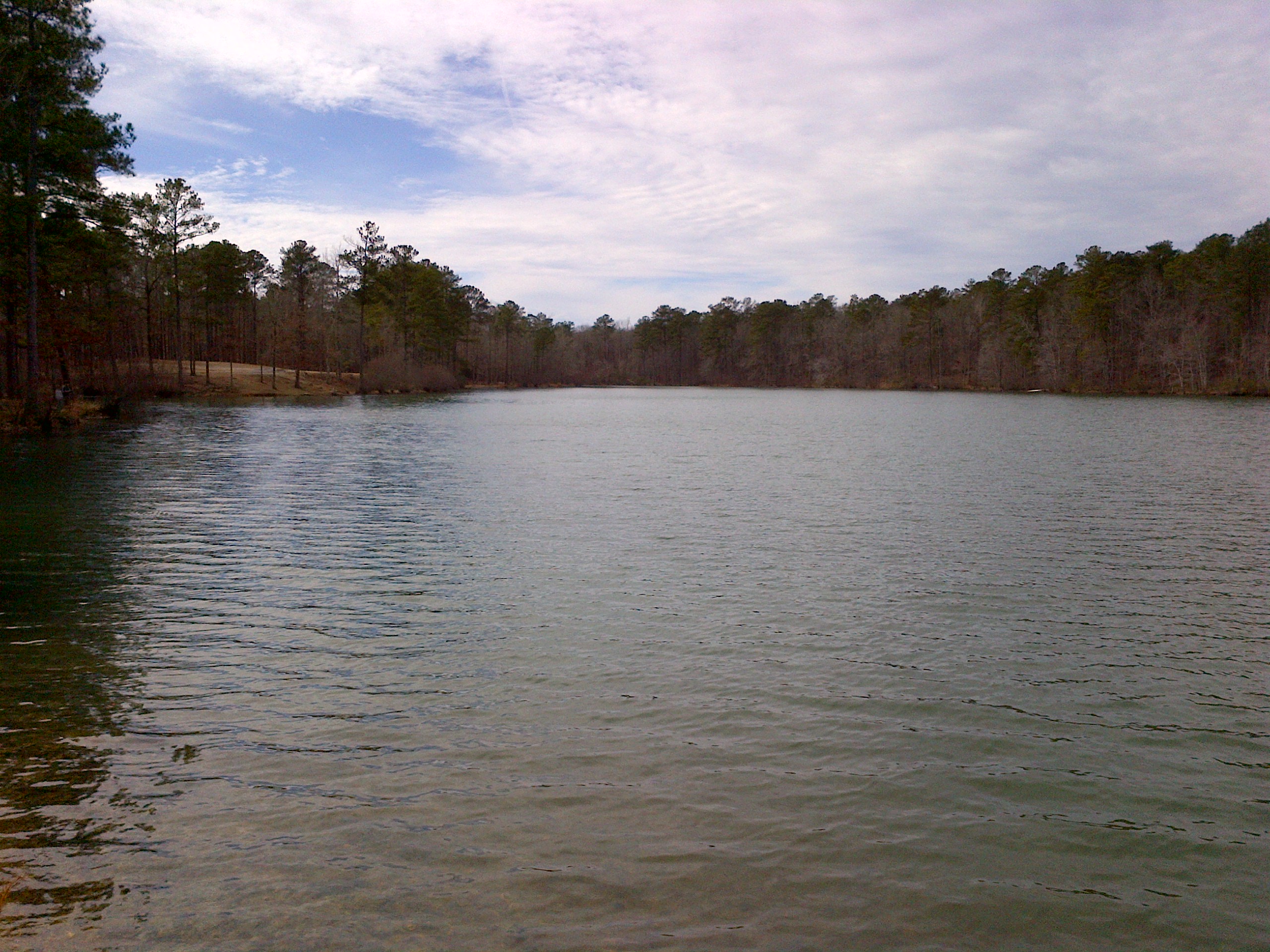
Oak Mountain State Park is amazing and a great place to practice for an adventure race.  There are miles of running and mountain biking trails as well as the o-courses.  There is even a nice lake for canoeing.  We plan on coming up here in the next month or two without the boys and having a long training day. I can’t wait!  And now for the fun part, I’m off to check Ana for ticks 😉

Alabaster-Helena-20140126-00340

Pangea Resolution AR


North, South, East, West…we don’t know which way is best!

Team Disoriented’s first adventure race of 2014 is in the books and I think we’re all very happy with our result.  We placed 9th in the Pangea Resolution AR, not bad for our second AR ever, and let me tell you the competition was fierce.  If you want to check out how real AR teams roll, check out the Canyoneros Race Report or Honey Stinger Race Report.   If you want to see how the amateurs do it, keep on reading…

Ranking

Good race performance starts with some top notch prep work, and we are masters of that.  Since Lake Apopka was the venue for the Resolution AR, a 6-hour drive for us, we wanted to leave around 1pm on Friday–which is really hard to do when Stu leaves work at 2:30.   No worries, Stu showed up at our place  and I asked where his new hitch-mount bike rack is that we’re going to use, and he replies that he thought we were using my new trunk mount bike rack.  You see, we were going to fit check “the bike rack “on his Ford Edge the night before, but we didn’t.

We arrived in Clermont, FL at 11PM, allowing for plenty of time to sleep before our 5AM wake-up call  to make the 6-7AM registration.  Lake Apopka is a 20 minute drive from our hotel but we weren’t too concerned about time since the pre-race meeting was at 7AM and the race didn’t start until 8.  We arrived around 6:30 and I think my first words were, “Holy crap, people are already camped out here. They have tents and tables set up.”  Actually I think my first words were, “Damn it’s cold, I thought this was south Florida.”

Lesson #1:There are some really serious competitors that race Pangea events

We stroll over to the registration table where we find out that teams are given maps at check-in…Oops.  At our first race, teams weren’t given maps or instructions until the race started.  We haven’t even put our bikes together or packed our gear and the other teams already have their transition areas set up and have been looking at the race packet for 30 minutes.

Lesson #2:  Get to the race early, set up, and be prepared to receive your race packet as soon as registration opens.

Race Planning

Race Packet and Instructions

Elite Passport

Resolution 2014 Elite Map 1

Resolution 2014 Elite Map 2

Resolution 2014 Elite Map 3

FOOT 1:

There didn’t seem to be much difference on how to attack Foot 1, so we just went to CP1 then CP2.  When the race began, I was surprised to see the field split into two with more than half going to CP1 and the remainder going to CP2.  What a weird feeling to have people run the opposite direction as you at the start of a race.  In hindsight, perhaps the top-ranked teams wait to see which CP most teams are going to first and then they choose a CP that less teams are going to so that they don’t get bogged down waiting for their turn to punch their passport…maybe not.

BIKE 1:

After CP2, we went back to the Main TA and began Bike 1.  We chose to stick to the yellow trail and pick up CP7, CP6, then CP5 on the way to the Boat TA, leaving CP 4 then CP3 for the return from the Boat TA.  We slightly overshot CP7 but quickly recovered once we saw the east-bound trail.  We backtracked and picked up CP7 and then moved on to CP6.

Lesson #3: Calibrate your bike odometer, it’s probably incorrect.

While heading south on the yellow trail towards CP6, it seemed like the hard-packed trail was deteriorating and becoming more overgrown.  So, when we shot onto the east-bound white trail to pick up CP6, we made a decision to continue east straight toward CP5 rather than backtracking to the yellow trail and continuing around.   Half-way between CP6 and CP5, I realized my error.  The white trails were much more difficult for us to traverse and we decided that in the future we would stick to the yellow trails as much as we could.  We finally made it to CP5 and made our way to the Boat TA.

BOAT:

You might find this hard to believe after watching the video, but we’ve actually been in a canoe before.  I don’t know what the hell happened.  I’m almost positive that we frightened a submerged alligator and in it’s hasty retreat it overturned our canoe…at least that’s my story.

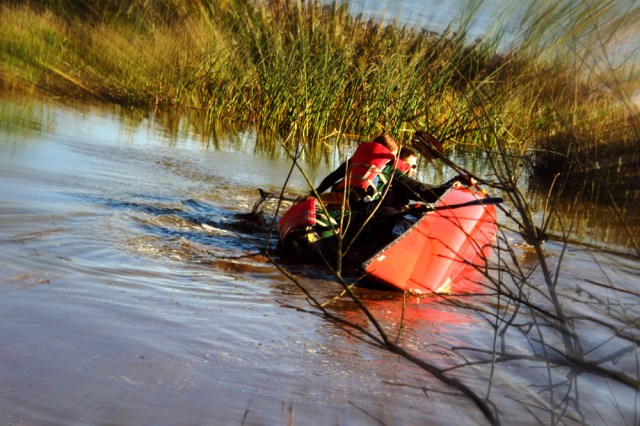
In the end, we capsized our canoe right in front of the launch area.  Ya know, if I’m going to look like an idiot I might as well do it in front of a crowd.  The water was frigid and it was like falling into a toilet.  Waist high in green swamp water and when I stepped, I would sink in the muck up to mid-calf.  The thought of being the first team eaten alive at a Pangea event had us out of the water pretty damn quick.  We had just been warned about a nesting alligator before the start of the race.  We got back on shore, emptied the boat and headed back out, wet, stinky and embarrassed.  Since we aren’t the best at canoeing, we planned to head towards CP10-CP13 and pick those up and then make a choice to get CP8 & CP9 on our return.  I thought this was a good strategy for maximizing points if we needed to bail without completing the leg.  A strong wind out of the north made paddling up to CP10 really difficult, especially since our confidence had been shattered with our capsize.  We paddled slow and hard, trying to keep the boat very stable.  Since we were soaked and the temperature was in the 50’s with a strong north wind, we were very cold.  To try to keep the boat stable, and since Ana only had a canoe paddle rather than a kayak paddle, I asked her not to paddle.  This made it very hard for her to warm up since she was just sitting there.  Luckily, Team Honey Stinger came by and loaned her a jacket.  We picked up CP10 and then planned to get CP13, CP11, then CP12.  Unfortunately, during the planning phase I didn’t realize that CP11 and 12 were in a canal, separated from CP13.  I realized this once we hit CP13 and we had to back track to get 11 & 12.  After that, we knew we were going to skip CP8 and CP9 as we were all extremely cold.

Lesson #4: Always carry an emergency blanket.  

Lesson #4b: Members of Team Honey Stinger are awesome.

BIKE 1 Cont:

We finished up Bike 1 by picking up CP4 then CP3 on the way back to the Main TA.  It took us a few minutes to find which of the many “Large Oak Trees” the CP was on, but we did find a geocache, which was pretty cool.  Post-race I evaluated our path and realized that we didn’t choose a very efficient route to CP3 from CP4.  We should have taken the blue route, rather than our red route marked below:

Bike 1

Lesson #5: Measuring distances on a map and then choosing the shorter and easier route can be a good thing.

FOOT 2:

We returned to the Main TA and put on a new pair of socks since our feet were still frozen and numb from the water.  While taking a few minutes to defrost, we met our TA neighbors and found out their support crew had grilled chicken for their team.  GRILLED CHICKEN!  Between slurps of Double Expresso Cliff Gel, I asked if their team was accepting new members as our support crew was failing miserably.  We hit CP14-17 in order and made a quick return down Ranch Rd to start Bike 3.

BIKE 3:

We haven’t been able to do much orienteering practice and thought this would be our weakest event so our strategy was to pick up all of the bike CPs before heading to the O-Course, if we had time.  Our attack plan was CP18, 19, 24, 23, 22, 21, and finally 20.  We stuck to the yellow trails whenever we could, which means we hit CP18 from the east.

Bike 3When we got to the north-bound trail to CP21, we saw that it was flooded.  Not knowing how bad the trail would be and running short on time to hit the orienteering section, we passed on it.  Afterwards we found out that only the first few meters were flooded and we probably could have picked it up and still made the cut-off.

Lesson #6: Don’t give up on a path too quickly.

O-COURSE:

We hit the O-Course last and with not much time to spare, but we thought we could pick up a few CPs.  Our plan of attack was CP29, 28, 25, 26, 27, and then 30.  But once we heard that some teams had taken hours to complete the course, we changed our plan to just getting CP30, 29, and possibly 28.  No problems picking up CP3o or CP29.  But from CP29 we chose to follow a path that took us somewhere between CP28 and CP27 and much too far south.  It was very frustrating during the time and more so once I saw the GPS plot of where we were.  But, we were getting short on time so we had to give up the CP and head back to the Main TA.

FINISH:

We should have done a better job estimating how much time it would take to get from the O-Course to the Main TA.  We knew that we would stay at the O-course for as long as possible and then make a straight run to the finish.  We ended up having almost 18 minutes to spare, arriving at 7:42:35.  We were exhausted, but we had a blast.  This was our toughest event to date and we can’t wait to do another one.  Big thanks to Pangea and the many AR teams that we met for making this event a great time for us.

Lesson #7: Post-race beer is good, next time we should bring some.

Team Photo Finish

2013 Backpacker Bushwhacker

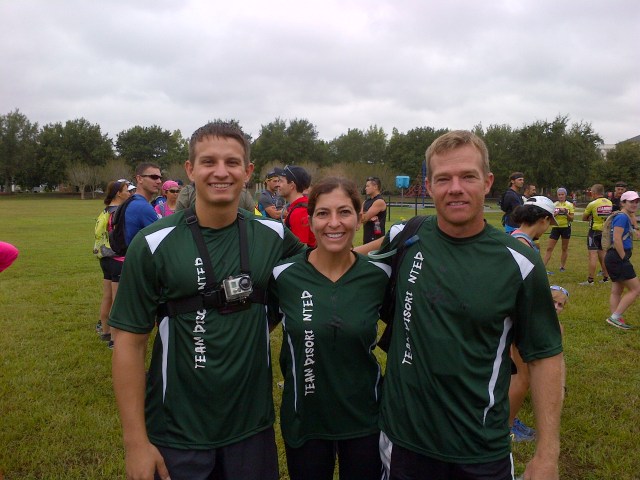
Forge RacingMaybe it was the Arctic Enema or perhaps the Electroshock therapy, I’m not sure but something happened during the Tough Mudder that made me want to find another event that would provide that same kind of thrill and physical challenge.  I knew that I wanted something team-based that my wife and I could do together and I wanted it to be adventurous, but not too adventurous.  I don’t mind a little thrill but I want to keep my shorts clean. So, we looked into Adventure Racing and decided to sign up for the first one closest to us, the 2013 Backpacker Bushwhacker in Lafayette, LA.  Stu, always up for a challenge, completed our 3-person coed team.  This was to be our first adventure race.  We weren’t quite sure what to expect, but we had a kick-ass logo and team shirts and that’s all one really needs.

Team photo (2)

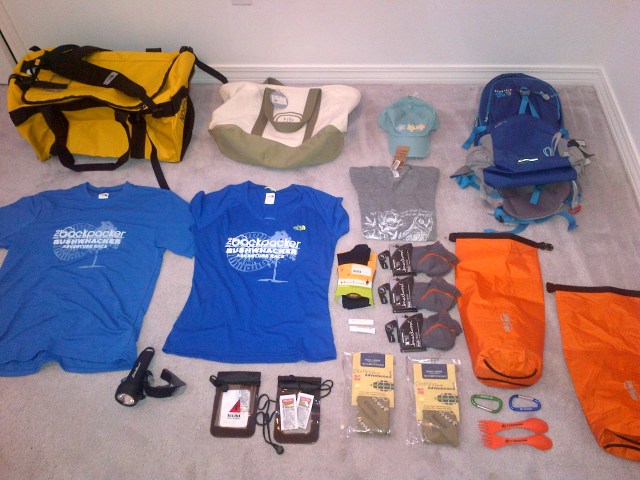
Since we didn’t know if we were going to like adventure racing, we didn’t want to spend much money gearing up for one.  Stu picked up a pretty nice Giant mountain bike from his buddy for $150 and we had a couple of Schwinns that we bought from Wal-Mart in ’03 that had been sitting around unused since then.  A few days prior to the race, I noticed that I had broken 3 spokes while training and my front tire was rubbing on the brake pad.  So, I ran my bike down to the local shop to get it fixed.  The morning we were leaving for the race, I picked up my bike and threw it into the back of Stu’s car without test riding it, and we hit the road.  The 6-hour drive was uneventful and we arrived at The Backpacker in time to register.  The volunteers at registration were awesome and we picked up some really sweet pre-race swag. Score!

backpacker logo

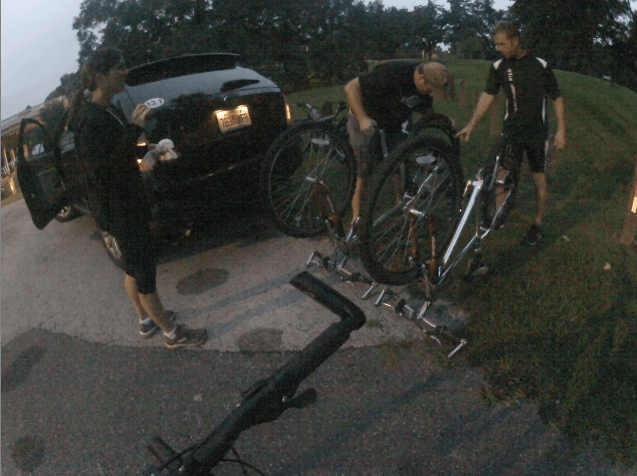
Race morning, we wake up and the first thing Ana says to me is, “I’m really dizzy.  I think I might have to go throw-up.” I suggest she might need to eat something and that with luck it might just go away.  She agrees and we all grab a bite and head to the bike drop-off area.  We assemble our bikes but it’s early in the morning, the sun hasn’t risen yet, and we can’t really see what we’re doing.   We get the tires on and go for a test ride.  Stu’s front brake is sticking and mine won’t stay in gear.  Not knowing anything about bikes, other than most have 2 wheels and a couple of pedals, I was at a loss for what to do.  Luckily, there was a volunteer at the drop-off who showed me how to adjust the rear derailleur so that it would stay in gear better.  Unfortunately, it would still pop out of gear if much torque was applied so I couldn’t quickly accelerate the whole race…how frustrating.  The guy also showed Stu how to adjust his brakes. By now, time was getting short for us to get to the mandatory pre-race meeting , so we left the bikes as they were and jumped in the car to leave.  Stu turns the key and all we hear is click…click…click, the battery is dead!  I guess in all of our messing around, we had left the interior lights on and forgot about them.  We asked a few people around us for a jump and once again, the bike repair guy comes over and saves us.  Thanks, Bike Angel Dude, for helping out and not making us feel like idiots!

bike fix

At the pre-race meeting, we start scoping the competition.  Everyone seems to be in full triathlon gear.  You know the tight fitting shirts with the padded bike shorts and top of the line running shoes.  One guy has a super deluxe backpack with hydration system built in and a hip belt into which he has tucked numerous gel packs.  I call him Batman. We start recollecting the Cannondales, Treks, and other nice bikes that we saw at the drop off area and the intimidation factor starts creeping in.  We jokingly refer to ourselves as Team Wal-Mart.  Of course, Stu is never intimidated, and I appreciate his confidence no matter how unfounded. We talk with a few people and everyone is really nice. You can feel the pre-race vibe in the air…everyone just wants to get going.

bpbw_map1

After a few delays, we are given the race map and told not to look at it until the official start. Everyone sets 5 hours on their watches and the countdown begins, 3, 2, 1…Go!  We rip open the package and see a Google Maps printout with 3 checkpoints (CPs).  We have to hit all three in a specific order (Boudreaux, Guidry, then Thibodeaux).  At the final CP, we’ll be given a new map.  We start running to the first CP, but mainly we’re just following the crowd.  The racers pretty much stay together and we all end up at Thibodeaux at the same time.  We’re given map #2 and the real race begins.

bpbw_map2

Race Instructions

On the run to Thibodeaux, we spotted where they staged our bikes and decide to run there first. We get to our bikes and I start looking at the map for the first checkpoint to attack (that’s cool Adventure Racing lingo for those that don’t know). I tell the team that we’ll head north and pick up CP26 before heading off to CP13.  Stu and Ana are cool with that and we get on our helmets. Being total noobs, we aren’t even sure if we can ride across the park area to the main road.  I think we even asked someone if it was okay to go that way.  While we’re trying to figure this out, I notice that EVERYONE is going south.  Hmm, hold on guys, let me take another look at that map.  I look again and see, for the first time, CP12 just to the south of us.  Ok, I guess we’ll get CP12 first and then CP26.

We find CP12 in a creek bed along with a few other people and we’re almost ready to make our first punch when someone tells us that it is not CP12 but rather CP8. Hmm, ok CP8 then.  We make the punch and then head north to find CP12.  We quickly run into a road, get our bearings, and realize that it really was CP12 and we’ve made an incorrect punch, oops. So we head back to the CP and punch our passport correctly.  Then I start thinking, if this is CP12 then where is CP8 that everyone was talking about.  I look on the map and don’t see CP8 listed.  What the hell!  We overhear other teams talking about taking a bearing from CP12 and I see them with a different sheet of paper.  Then we remember the instruction sheet we got with the map.  On it is a table of unmapped checkpoints that we had completely disregarded. CP8 is 360ft at bearing S51W from CP12.  I quickly shoot a bearing and the hunt is on.  After carefully measuring our steps, we locate CP8, punch our passport and get going.

After picking up 2 checkpoints that we would have completely skipped, we are off to pick up CP26 as originally planned.  For the first time during the race, there are no other racers around.  I’m somewhat glad but a little nervous too, wondering where they have gone and why they aren’t going after CP26 as well.  We have an uneventful ride to where CP26 is supposed to be, but we can’t find it.  All I could say was, “It should be right here!” which didn’t help at all.  I think we wasted 10 minutes looking for it before realizing that the CP was accidently marked incorrectly and it was on the opposite side of the road.  Unfortunately, since this was our first race, it made us wrongly assume that checkpoints weren’t necessarily inside the circled area on the map.  So, to compensate, we allowed our search area to broaden beyond the circled areas which increased the amount of time we spent finding subsequent CPs.

After CP26 we hit CP13, CP15, and then tried to attack CP16.  On the map, CP16 is clearly shown west of a creek but given our previous issue with CP26, we thought the CP might be on either side.  We decided to attack it from the east since we are already nearby.  Unfortunately, the “creek” turned out to be a fenced off, impassable culvert and the CP was definitely not on the east side.  Stu was ready to climb the fence and go across the culvert—bikes in hand mind you—but I absolutely refused.  Instead, we left it for later and attacked CP14 and the unmapped CP9.  Another team had been close by us during this time and although we were all looking for the same CPs, they were finding them before us.  We weren’t trying to follow them, but when one team signals that they’ve found the CP, what else are you going to do besides go over there and get your passport punched?  We felt a little bad and so we decided to let them know about CP26 and how the map was wrong and it could be found hidden on the other side of the road.  I don’t know if they ever got to CP26 but it made us feel better.

After CP9, we attacked CP16 again and found out that it was at the Rok Haus, a rock climbing gym.  In order to get your passport stamped your team had to harness up and climb to the top of a wall.  That was awesome and completely unexpected.  We then went to CP10 where we could finally get off our bikes and do some land navigation.  CP10, was at Red Lerille’s Health & Racquet Club where we had to do lunges for 50 feet, 20 squats, and run around a small track while carrying 25lbs to get our passport punched.  Not so easy after biking all morning.  Off we ran to CP5 where we had to swim 3 laps of 50 meters to get our punch, and I discovered that I am the worst swimmer ever.  Both Ana and Stu finished well before me as I flopped around like a gorilla trying not to drown.  It was horrible.

CP1 through 7 could only be accessed by foot.  They were all hidden in a forested area and it took us a long time to find them.  We ended up skipping CP2 due to time.  CP6 was unmapped and could be found by taking a bearing from CP4.  We took a bearing and measured our paces from CP4, but didn’t find CP6 at first.  I began to question my orienteering, since it took us to the middle of a field, and I thought that all checkpoints would be hanging from something.  We finally found it lying flat on the ground in tall grass and I was really happy.  At CP3, we found the ropes section of the course where teams had to harness up and pull themselves across a small gulley to receive their punch.  It was fun, but I was hoping for a little more rope work during the course.

After CP3, we knew we would never make the paddling section of the race and decided to hop on our bikes and pick up as many additional checkpoints as we could in the time remaining.  We hit CP17, CP18, CP19, and CP20 without any hiccups. We skipped CP21 as we weren’t sure how we were going to get there and didn’t want to get lost. We then had to decide if we were going to go for CP11 and CP25.  Both of these were south of the Vermillion River and the only way to get there from CP20 was to ride on Hwy 182 and cross at Pin Hook Bridge.

We decided to give Hwy 182 a try and pick up CP25 since it was worth 2 points.  I will say that for the first time during the race I was scared.  I don’t like riding on busy streets and I definitely don’t like crossing bridges on busy street.  We pedaled fast, stuck together like a big train and prayed that we wouldn’t get hit by some idiot texting “Wassup!” to his buddy.  We were a blur of green and silver.  We hit CP25 and decided to skip CP11 since time was really close and it was only worth 1 point.  Being late to the finish would cost us 3 points per 15 minutes.

We left CP25 and rode like mad to the finish area.  We arrived at 5 hours and 5 minutes, giving us 9 minutes to spare.  We were very tired but really excited.  Our biggest regret was not getting to the canoe section since we were really looking forward to trying that.  Overall, the race was great.  We had a blast.  The organizers and racers were super cool and the event was challenging and fun.  We learned a lot about adventure racing and I think we performed pretty well for our first time.  We definitely plan on going back next year and we highly recommend it for first timers as well as for those with more experience. Oh, and did I mention swag?  Not only did we get stuff during registration, but post-race there was a massive raffle of some really sweet stuff.  I’m talking really nice stuff like North Face bags, hydration packs, ski goggles, etc.  I don’t know how the organizers did it, but everyone went home with something nice

swag

As for Ana and her morning dizziness, she only got worse during the race.  In fact, she spent the 6-hour car ride home throwing up every hour or so.  Under some overpass on I-10 there is a Ziploc bag containing the remnants of the Bonefish Grill sandwich they gave us at the post-race party. What a waste ’cause those sandwiches were AWESOME!  She’s fully recovered now and ready to do another one!

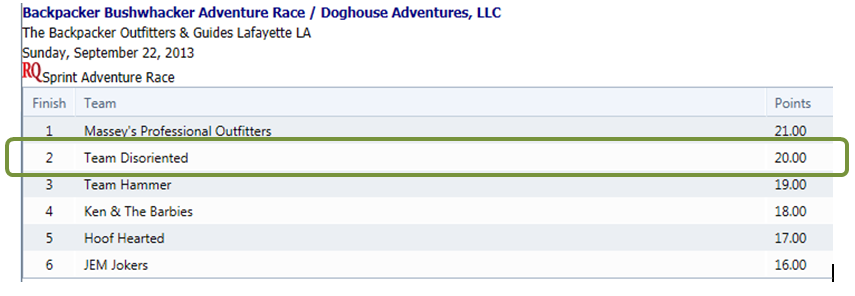
bpbw_results

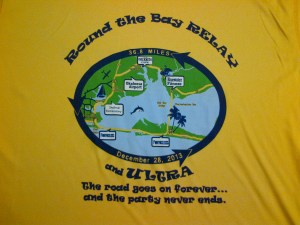
Round the Bay Relay and Ultra

LogoSince we missed the Turkey Burn AR and there weren’t any adventure races close to us between now and the Resolution AR in January, we decided to sign up for the Round the Bay Relay and Ultra.  Stu was visiting his family in south Florida and couldn’t make it, so we ran it as a 2-person relay.  The day prior to the race, the forecast called for 100% rain with up to 1 inch per hour and temps in the low 50’s.  Let’s just say that neither Ana nor I were very excited by this.  We live in Florida so we don’t do cold weather very well and we consider anything less than 70 degrees to be cold.  We made a late night decision to run to Columbia at Silver Sands Outlet to look for rain gear that we could wear during the race.  Ana got a sweet deal on the Compounder rain jacket and I chose the Tech Attack.  There are some really nice benefits to living close to an outlet mall as the prices were much lower than retail.  We also scored some new gloves.  Paired with our Under Armour cold gear that we got before Tough Mudder, we were set.

Our start time was 6:30AM.  The race course started at Fudpucker’s on Okaloosa Island and made a giant loop around Choctawhatchee Bay for a total distance of 36.77 miles.

map

Luckily for us, the forecasted downpour stayed away.  While it drizzled the whole race and the temps started in the 40’s, the weather was much better than it could have been.

I thought that the relay format was a lot of fun and we look forward to doing it again next year but with a team rather than a pair.  Not because the mileage is too much, but rather because we think doing it as a team relay will make it a lot more fun.

I don’t have our official time but looking at the Runtastic GPS time, it appears that we averaged an 8:30 mile pace, which for us is pretty good.  The best part is that supposedly we burned 2550kcal each and so I feel no shame having eaten the pizza, beer and Oreos post race.

IMG-20131228-00253